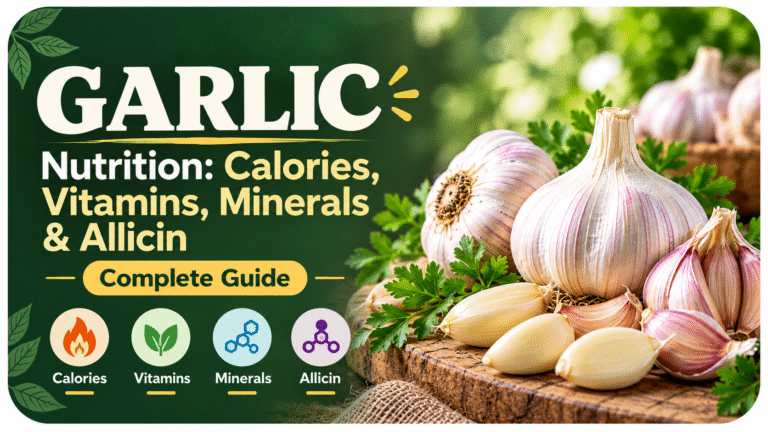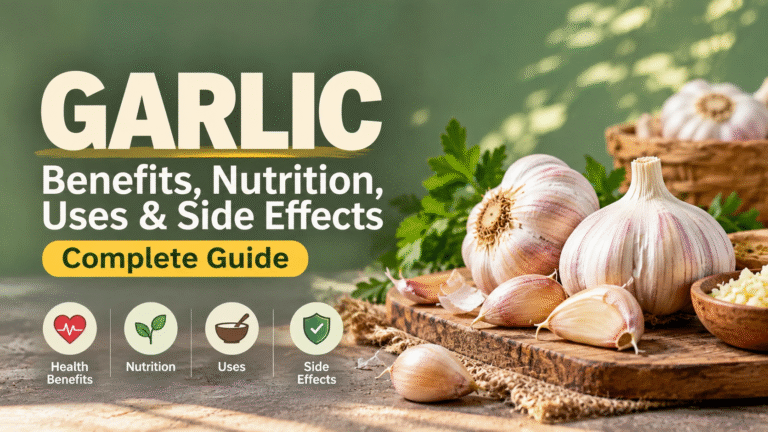
Garlic (Allium sativum) is one of those ingredients that seems to belong in almost every kitchen. It adds a sharp, savory flavor to soups, sauces, marinades, stir-fries, roasted vegetables, and countless other dishes. Beyond its culinary role, garlic has also been studied for its nutritional properties and potential effects on several aspects of health.
What makes garlic particularly interesting is its sulfur-containing compounds. When a garlic clove is crushed or chopped, chemical reactions produce compounds such as allicin, which are responsible for much of its characteristic smell and have been the subject of extensive scientific research.
Garlic can be eaten fresh, cooked, roasted, dried, powdered, or used in concentrated supplement forms. However, these forms are not interchangeable, and evidence from garlic supplements should not automatically be applied to an ordinary serving of garlic in food.
This guide explains what garlic is, its nutritional value, potential health benefits, common uses, different forms, and the safety considerations worth knowing before making it a daily habit.
What Is Garlic?
Garlic is a bulb-forming plant belonging to the Allium genus. Its scientific name is Allium sativum. The underground bulb is made up of individual cloves, which are surrounded by a papery outer skin.
Garlic is cultivated and eaten around the world. It is especially valued as a culinary ingredient because a small amount can dramatically change the flavor of a dish.
Fresh garlic has a relatively mild aroma when the clove is intact. Once it is cut, crushed, or chopped, its smell becomes much stronger. That change is not accidental—it comes from chemical reactions occurring inside the damaged garlic tissue.
Garlic Bulb vs Garlic Clove
A garlic bulb is the complete head of garlic you buy at the grocery store.
A garlic clove is one of the individual sections inside the bulb.
A typical bulb contains multiple cloves, although the number and size vary depending on the garlic variety.
When recipes call for “one clove of garlic,” they are referring to one of these individual sections rather than the entire bulb.
Why Does Garlic Smell So Strong?
The familiar garlic aroma is closely connected to its sulfur-containing compounds.
One of the best-known compounds is allicin. It is formed when garlic tissue is damaged, such as when a clove is crushed or chopped.
This chemistry is also one reason garlic is more pungent after preparation than it is when the clove is still intact.
Garlic Nutritional Value
Garlic is usually consumed in relatively small amounts, so it is better thought of as a nutrient-containing culinary ingredient rather than a major source of calories or protein.
It contains carbohydrates, small amounts of protein and fiber, and several vitamins and minerals. More importantly, garlic contains a variety of biologically active sulfur compounds and other phytochemicals that have attracted considerable research interest.
What Nutrients Are Found in Garlic?
Garlic provides small amounts of nutrients including:
- Vitamin B6
- Vitamin C
- Manganese
- Selenium
- Fiber
- Carbohydrates
- Protein
The exact nutritional profile varies with serving size, variety, growing conditions, storage, and preparation. For a more detailed breakdown of calories, vitamins, minerals, fiber, and garlic’s bioactive compounds, see our guide to garlic nutritional value.
Because most people eat garlic as a seasoning or ingredient rather than in large portions, its nutritional importance is not simply about calories, vitamins, or minerals.
What Compounds Make Garlic Interesting?
Garlic contains several sulfur-containing compounds, including:
- Alliin
- Allicin
- Ajoene
- Diallyl sulfides
- Other organosulfur compounds
These compounds can change depending on how garlic is handled, processed, stored, and cooked.
What Is Allicin in Garlic?
Allicin is one of the compounds most commonly associated with freshly crushed garlic.
Interestingly, intact garlic does not simply contain a large reservoir of ready-made allicin. Instead, crushing or cutting the clove brings alliin into contact with the enzyme alliinase, which leads to the formation of allicin.
Allicin is chemically reactive and relatively unstable, so it can quickly transform into other sulfur-containing compounds.
This is one reason garlic’s chemistry is more complicated than simply saying that “garlic contains allicin.”
What Happens When You Crush Garlic?
When you crush or finely chop a garlic clove, its cells are damaged.
That allows alliin and alliinase to interact, producing allicin and other sulfur compounds.
The reaction contributes to garlic’s strong aroma and pungent flavor.
Research reviews describe allicin as a highly reactive organosulfur compound and examine its biological activity in laboratory and nutritional research. However, findings from laboratory experiments should not automatically be interpreted as proof that eating garlic treats a particular disease.
Garlic Health Benefits
Garlic health benefits are one of the main reasons people are interested in the ingredient. Scientific research has investigated garlic and garlic preparations in relation to cholesterol, blood pressure, blood sugar, cardiovascular health, immune function, and other outcomes.
The important distinction is between potential effects observed in research and proven medical treatments.
Much of the clinical evidence discussed by major health organizations involves garlic supplements or standardized preparations rather than simply adding a clove of garlic to a meal.
1. Cardiovascular Health
Garlic has been extensively studied for its possible relationship with cardiovascular health.
Research on garlic supplements has examined markers such as total cholesterol, LDL cholesterol, blood pressure, and other cardiovascular risk factors.
According to the National Center for Complementary and Integrative Health, garlic supplements may produce small reductions in total and LDL cholesterol in people with high cholesterol. Some evidence also suggests small reductions in blood pressure among people with hypertension.
These findings are interesting, but garlic should not be viewed as a replacement for prescribed treatment or a balanced diet.
2. Cholesterol
Cholesterol is another area where garlic has been researched extensively.
Some clinical studies and reviews have reported reductions in total cholesterol and LDL cholesterol with garlic preparations. However, the size of the effect varies between studies, and the evidence generally concerns supplements or specific preparations.
If you are trying to manage high cholesterol, garlic can be part of a healthy eating pattern, but it should not replace medications or medical advice when those are needed.
3. Blood Pressure
Garlic supplements have also been studied in people with high blood pressure.
The available evidence suggests that garlic may have a modest effect on blood pressure in some people. The effect is not comparable to assuming that eating raw garlic will immediately lower blood pressure.
For someone with hypertension, garlic is better viewed as a food that can fit into an overall healthy diet rather than as a standalone treatment.
4. Blood Sugar and Metabolic Health
Garlic has been studied in relation to blood glucose and diabetes as well.
Some research on garlic supplements suggests a small reduction in blood sugar in people with diabetes. However, the results depend on the type of preparation, dose, duration, and population being studied.
More importantly, eating garlic does not mean that someone with diabetes can ignore their prescribed treatment or dietary plan.
5. Antioxidant Activity
Garlic contains sulfur compounds and other phytochemicals that have antioxidant-related activity.
Antioxidants are compounds involved in processes that help protect cells from oxidative damage. Laboratory research has demonstrated biological activity for several garlic compounds, including allicin.
However, antioxidant activity measured in a laboratory is not the same thing as proving a specific health outcome in humans.
That distinction matters when evaluating claims about “superfoods” and natural remedies.
6. Immune Function
Garlic is often promoted online as an immune booster, particularly during cold and flu season.
There has been some research on garlic supplements and respiratory infections, but the evidence remains limited. The National Institutes of Health notes that only a small number of studies have examined whether garlic supplements help prevent the common cold or flu, and it is still unclear how useful garlic is for this purpose.
So while garlic can certainly be part of a nutritious diet, claims that it dramatically “boosts immunity” or prevents infections go beyond what the current evidence establishes.
7. Digestive Health
Garlic has traditionally been used in many food cultures as part of meals and herbal preparations intended to support digestion.
Some people tolerate garlic very well, while others experience gas, abdominal discomfort, heartburn, or nausea—particularly after eating larger amounts or raw garlic.
That means garlic is not automatically beneficial for everyone’s digestive system.
What Does the Research Actually Say?
One useful way to think about garlic research is to separate promising evidence from strong conclusions.
| Area studied | What research suggests |
|---|---|
| Cholesterol | Garlic supplements may produce modest reductions in total and LDL cholesterol |
| Blood pressure | Some evidence suggests a small reduction in people with high blood pressure |
| Blood sugar | Garlic supplements may have a small effect in people with diabetes |
| Immune function | Evidence is limited and not yet conclusive |
| Antioxidant activity | Garlic compounds show biological activity, but laboratory findings do not automatically equal clinical benefits |
| Cancer prevention | Evidence is not strong enough to recommend garlic as a cancer-prevention treatment |
The form of garlic matters as well. Research on concentrated supplements cannot simply be translated into a specific number of raw garlic cloves per day.
Uses of Garlic
Garlic has two broad roles: it is a widely used food ingredient, and it is also sold in concentrated preparations and supplements.
Garlic in Cooking
Garlic can be used in:
- Soups
- Sauces
- Curries
- Stir-fries
- Marinades
- Salad dressings
- Pasta dishes
- Roasted vegetables
- Meat and seafood dishes
- Dips and spreads
Its flavor changes considerably depending on how it is prepared.
Raw garlic is sharp and pungent. Cooked garlic becomes softer and sweeter, while roasted garlic develops a mild, almost creamy flavor.
Garlic is one of the most widely used culinary ingredients and is often combined with herbs and spices in everyday cooking. It can be used fresh, roasted, sautéed, or added to sauces and other dishes.
If you’re interested in other traditional ingredients used in wellness drinks, see our guide to Indian detox drinks for weight loss.
Raw Garlic
Raw garlic can be chopped, minced, grated, or crushed and added to foods.
If you’re looking for practical ideas on how to eat garlic, including raw, cooked, and roasted preparations, see our complete guide.
Some people also eat raw garlic on its own because of its traditional reputation as a health food.
However, raw garlic tends to be more pungent and can be harder on the stomach than cooked garlic for some people.
There is no requirement to eat garlic raw to include it in a healthy diet.
Cooked and Roasted Garlic
Cooking changes garlic’s flavor, texture, and chemical composition.
Roasting is one of the easiest ways to make garlic milder. Whole bulbs can be roasted until the cloves become soft enough to spread on bread, vegetables, or other foods.
Cooking is often the most practical way to eat garlic regularly because it makes the ingredient easier to incorporate into normal meals.
Garlic Powder
Garlic powder is made from dried garlic and is commonly used as a seasoning.
It is convenient and has a longer shelf life than fresh garlic. However, dried garlic products differ from fresh cloves in flavor, texture, water content, and chemical composition.
Garlic powder should also be distinguished from garlic salt, which contains added salt.
Garlic Supplements
Garlic supplements are available as tablets, capsules, extracts, oils, and other preparations.
These products can contain different forms and concentrations of garlic compounds, so they should not be treated as nutritionally equivalent to a fresh garlic clove.
If someone is taking garlic specifically for a health purpose, it is particularly important to consider the product, dose, possible interactions, and evidence behind that preparation.
Types and Forms of Garlic
Garlic is available in many forms, and the differences are not purely cosmetic.
Fresh Garlic
Fresh garlic is sold as whole bulbs containing individual cloves.
It is the most common form used in everyday cooking.
Raw Garlic
Raw garlic is simply garlic that has not been cooked.
It has a strong flavor and aroma and is often finely chopped or crushed before being added to food.
Black Garlic
Black Garlic is produced by controlled aging or processing under specific temperature and humidity conditions.
The cloves become dark, soft, and sweeter, with a flavor that is very different from fresh garlic.
Black garlic has become increasingly popular in food and wellness discussions, and researchers have also investigated how processing changes its chemical composition.
For a deeper look:
Black Garlic: Benefits, Nutrition, Uses & Side Effects
Garlic Powder
Garlic powder is made by drying and processing garlic.
It is useful when you want garlic flavor without peeling and chopping fresh cloves.
Aged Garlic Preparations
Aged garlic products are processed differently from ordinary fresh garlic and are commonly sold as supplements.
Because processing can alter the compounds present in garlic, research on aged garlic extracts should not automatically be applied to fresh garlic used in cooking.
Raw Garlic vs Cooked Garlic
The choice between raw garlic vs cooked garlic is not as simple as declaring one universally “better.”
Raw garlic has a stronger flavor and provides a different chemical environment because crushing creates reactive sulfur compounds such as allicin.
Cooking changes the chemistry of garlic, and the extent of the change depends on factors such as temperature, cooking time, and preparation method.
From a practical standpoint:
- Raw garlic: sharper flavor and more pungent
- Cooked garlic: milder flavor and softer texture
- Roasted garlic: sweet, creamy, and mild
- Garlic powder: convenient and shelf-stable
If your goal is simply to eat more garlic as part of a balanced diet, choose the form you enjoy and can use consistently.
For a detailed comparison, see:
Raw Garlic vs Cooked Garlic: Nutrition, Benefits & Differences
Garlic and Honey
Garlic & Honey has become a popular combination in wellness content, especially in recipes involving fermented garlic honey.
The combination is appealing because garlic contributes its pungent, savory character while honey provides sweetness. Some people also use the mixture as a traditional home remedy.
However, popularity should not be confused with clinical evidence.
Claims that garlic and honey can “detox” the body, burn fat, cure infections, or replace medical treatment are not established simply because the ingredients have individually been studied.
If you want to try the combination as a food, focus on preparation, food safety, portion size, and your own tolerance.
For the detailed topic:
Garlic & Honey: Benefits, Uses, Recipe & Risks
Garlic Safety & Side Effects
Garlic is generally well tolerated in the amounts commonly used as food.
That does not mean that more garlic is always better.
Common Side Effects
Some people may experience:
- Bad breath
- Body odor
- Gas
- Abdominal discomfort
- Heartburn
- Nausea
These effects can be more noticeable after eating large amounts of raw garlic.
If you want a more detailed look at garlic side effects, including potential risks, dosage considerations, and medication interactions, see our dedicated guide.
For more information on the research and safety of garlic, see the National Center for Complementary and Integrative Health (NCCIH) guide to garlic.
Can You Eat Garlic Every Day?
For most people, eating garlic regularly as part of normal meals is not unusual and can fit comfortably into a balanced diet. If you’re specifically interested in eating raw garlic every day, including what may happen with regular consumption and the potential downsides, see our detailed guide.
The situation is different when someone is consuming large quantities of raw garlic or taking concentrated garlic supplements.
There is no universal “maximum number of cloves” that applies to everyone because tolerance, preparation, health conditions, and supplement formulations vary.
Garlic Supplements and Bleeding Risk
Garlic supplements may affect blood clotting and can increase bleeding risk, particularly when combined with medicines that also affect bleeding.
This is particularly relevant for people taking anticoagulants or antiplatelet medicines, and for anyone preparing for surgery.
Anyone in this situation should discuss garlic supplements with a healthcare professional rather than assuming that a natural product is automatically safe.
Garlic and Medication Interactions
Garlic may interact with certain medicines, including some medications that affect blood clotting or blood pressure.
This is one reason concentrated supplements deserve more caution than ordinary culinary use.
Who Should Be Cautious With Garlic Supplements?
Extra caution is sensible for people who:
- Take blood-thinning medication
- Take medicines for blood pressure
- Are preparing for surgery
- Have known allergies to garlic
- Experience significant digestive symptoms after eating garlic
- Are considering high-dose garlic supplements
Fresh raw garlic should also not be applied directly to the skin as a home remedy. Concentrated raw garlic can cause severe skin irritation and even chemical burns.
How Much Garlic Should You Eat?
There is no single evidence-based number of garlic cloves that every adult should eat each day.
The amount used in ordinary cooking is very different from the doses used in supplement research.
This distinction is important because studies may use standardized garlic preparations containing specific amounts of particular compounds, while a fresh garlic clove varies in size, variety, age, storage conditions, and preparation.
For everyday eating, the practical approach is to use garlic as one ingredient within a varied diet rather than treating a large amount as a daily medicine.
If you are considering a concentrated garlic supplement for a specific health condition, discuss the product and dose with a qualified healthcare professional.
Frequently Asked Questions About Garlic
Is garlic good for you?
Garlic can be a nutritious part of a balanced diet and contains sulfur-containing compounds and other bioactive substances. Research has investigated garlic preparations for cardiovascular and metabolic health, although the size and strength of the evidence vary by outcome and preparation.
Can you eat garlic every day?
Most people can include normal culinary amounts of garlic in their diet regularly. Eating very large amounts, particularly raw garlic, may cause digestive discomfort and other side effects.
Is raw garlic better than cooked garlic?
Not necessarily. Raw and cooked garlic have different flavors, textures, and chemical profiles. Crushing raw garlic promotes the formation of allicin, while cooking changes the composition of its sulfur compounds.
What is the healthiest way to eat garlic?
There is no single healthiest preparation for everyone. Fresh garlic can be added to balanced meals, while roasted or cooked garlic may be easier to tolerate for people who find raw garlic irritating.
What is allicin in garlic?
Allicin is a reactive sulfur-containing compound formed when garlic tissue is damaged. Crushing or chopping garlic allows alliin and the enzyme alliinase to interact, producing allicin.
Can garlic cause side effects?
Yes. Common oral side effects include bad breath, body odor, gas, abdominal discomfort, heartburn, and nausea. Garlic supplements can also present additional interaction and bleeding considerations.
Is garlic safe for everyone?
Garlic used as a food is generally well tolerated, but concentrated supplements are not appropriate for everyone. People taking certain medications or preparing for surgery should discuss garlic supplements with a healthcare professional.
Does garlic help with blood pressure?
Some research suggests garlic supplements may produce a small reduction in blood pressure in people with high blood pressure. This does not mean that eating garlic can replace prescribed blood-pressure treatment.
Garlic is much more than a flavoring ingredient, but it is also not a miracle food.
It contains sulfur-containing compounds such as alliin and compounds formed from it, including allicin, which have been widely studied. Research suggests that some garlic preparations may have modest effects on cardiovascular and metabolic markers, while evidence for other popular claims remains limited.
For most people, the simplest way to enjoy garlic is as part of normal meals. Raw, cooked, roasted, powdered, and aged forms all have different characteristics, and there is no need to force yourself to consume large amounts of raw garlic to get value from it.
If you are considering garlic supplements for a specific health concern, pay attention to the preparation, dose, possible medication interactions, and the quality of the evidence.
Garlic works best as part of an overall healthy eating pattern—not as a substitute for one.