
Use our free online BMI Calculator to estimate your Body Mass Index in seconds. Enter your height and weight to find out whether your BMI falls into the underweight, healthy weight, overweight, or obesity category. This calculator is suitable for most adults and provides a quick starting point for understanding your overall health.
Calculate BMI, BMR and Estimated Daily Calories.
Body Mass Index (BMI) is a screening tool that estimates whether your weight is appropriate for your height. It is calculated using your height and weight and is commonly used to classify adults as underweight, healthy weight, overweight, or obese. Although BMI does not directly measure body fat, it is a quick way to assess weight-related health risks.
Although BMI does not directly measure body fat, it is considered one of the easiest screening tools for identifying potential health risks related to weight. Healthcare professionals around the world use BMI as an initial assessment before recommending further medical evaluations.
Body Mass Index (BMI) is widely used as a screening tool by healthcare professionals around the world. According to the World Health Organization (WHO), BMI is one of the standard methods used to classify weight status in adults.
Using the BMI Calculator is simple and takes only a few seconds.
The calculator will instantly display:
BMI is calculated using a simple mathematical formula:
BMI = Weight (kg) ÷ Height² (m²)
If your weight is 70 kg and your height is 170 cm (1.70 m)
BMI = 70 ÷ (1.70 × 1.70)
BMI = 24.2
This falls within the Healthy Weight category.

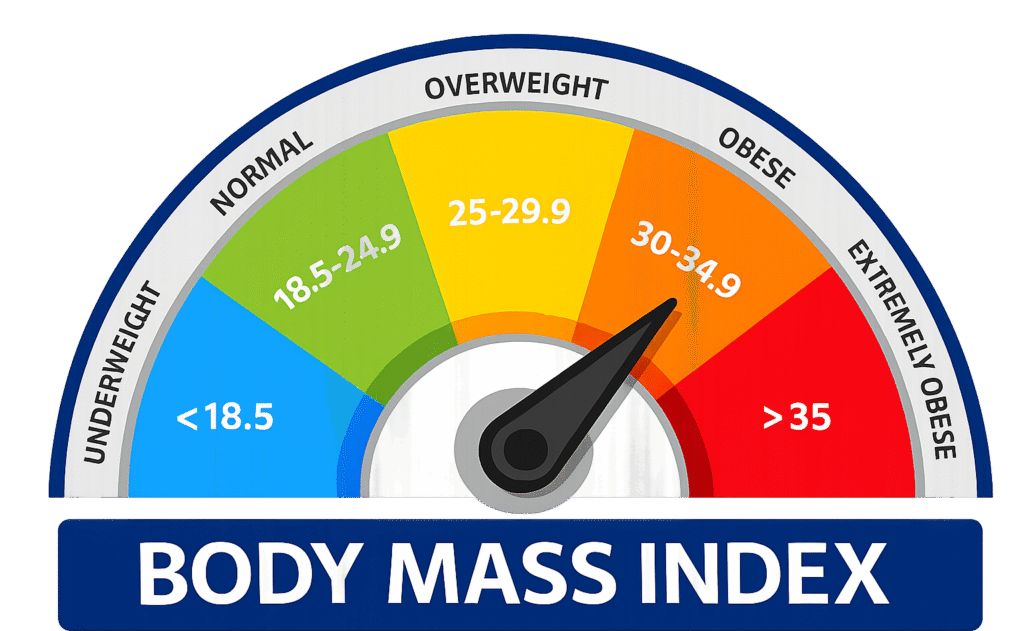
Our BMI Categories Chart provides a simple way to interpret your BMI score after using the calculator. Once you calculate your Body Mass Index, compare your result with the chart below to identify your weight category. Understanding your BMI category can help you assess potential health risks and make informed decisions about your diet, exercise, and overall lifestyle. While BMI is a useful screening tool, it should be considered alongside other health indicators for a complete assessment.
| BMI Range | Weight Category | Health Risk |
|---|---|---|
| Below 18.5 | Underweight | Nutritional deficiencies |
| 18.5–24.9 | Healthy Weight | Low |
| 25–29.9 | Overweight | Increased |
| 30–34.9 | Obesity Class I | High |
| 35–39.9 | Obesity Class II | Very High |
| 40+ | Obesity Class III | Extremely High |
The BMI categories used in this calculator are based on internationally recognized guidelines. You can also learn more from the Centers for Disease Control and Prevention (CDC).
Note: BMI categories are designed for adults and may not be suitable for children, pregnant women, athletes, or individuals with high muscle mass.
A healthy BMI for most adults falls between 18.5 and 24.9. Maintaining a healthy BMI is associated with a lower risk of developing chronic conditions such as type 2 diabetes, high blood pressure, heart disease, and certain types of cancer.
However, BMI should always be interpreted alongside other health factors, including body composition, waist circumference, physical activity, and overall lifestyle.
While BMI is a useful screening tool, it has several limitations.
It does not distinguish between muscle and body fat. Athletes or individuals with high muscle mass may have a higher BMI despite having low body fat. Similarly, older adults may have a normal BMI while carrying excess body fat.
BMI is also not designed for pregnant women, young children, or individuals with certain medical conditions.
For a complete assessment of your health, BMI should be used alongside other measurements such as waist circumference, body fat percentage, and professional medical advice.

A healthy BMI for most adults falls between 18.5 and 24.9. Maintaining a healthy BMI is
Keeping your BMI within the healthy range offers several long-term health benefits:
associated with a lower risk of developing chronic conditions such as type 2 diabetes, high blood pressure, heart disease, and certain types of cancer.
However, BMI should always be interpreted alongside other health factors, including body composition, waist circumference, physical activity, and overall lifestyle.
Maintaining a healthy BMI involves consistent lifestyle habits rather than quick fixes.
BMI is a reliable screening tool for most adults, but it does not directly measure body fat or muscle mass.
A BMI between 18.5 and 24.9 is considered healthy for most adults.
Checking your BMI every few months is sufficient for most people unless you are actively working toward a weight-management goal.
The BMI formula remains the same for adults, but health interpretation may vary with age and individual circumstances.
Athletes often have more muscle mass, which can increase BMI without indicating excess body fat.
An Online BMI Calculator is a free digital tool that helps you calculate your Body Mass Index (BMI) using your height and weight. It instantly estimates whether you fall into the underweight, healthy weight, overweight, or obesity category based on standard BMI guidelines. Our Online BMI Calculator also estimates your BMR and daily calorie needs, making it easier to understand your overall health and fitness goals.
You can calculate your BMI using the formula:
BMI = Weight (kg) ÷ Height² (m²)
For example, if you weigh 70 kg and your height is 170 cm (1.70 m):
BMI = 70 ÷ (1.70 × 1.70) = 24.2
If you don’t want to calculate it manually, simply use our Online BMI Calculator to get your BMI, BMR, and daily calorie estimate instantly.
If your height is 170 cm and your weight is 70 kg, your BMI is approximately 24.2. This falls within the Healthy Weight category according to standard BMI classifications.
For most adults aged 18 years and older, a healthy BMI is between 18.5 and 24.9. While age can affect body composition, the standard BMI ranges remain the same for adults. Older adults, athletes, and pregnant women may need additional health measurements beyond BMI.
To maintain your current BMI, you should consume approximately the same number of calories that your body burns each day. This is known as your maintenance calories, which depend on your BMR and activity level.
BMR (Basal Metabolic Rate) is the number of calories your body needs each day to perform basic functions such as breathing, blood circulation, and maintaining body temperature while at rest. Our BMI Calculator also estimates your BMR based on your age, gender, height, and weight.
BMI (Body Mass Index) measures whether your weight is appropriate for your height, while BMR estimates the number of calories your body burns at rest. BMI helps assess your weight category, whereas BMR helps estimate your daily calorie needs. Our calculator provides both values to give you a better understanding of your health.
Our BMI Calculator includes a BMR estimate to provide more useful health insights. While BMI tells you your weight category, BMR helps estimate how many calories your body needs each day. Together, these values can support weight management, fitness, and nutrition planning.